
Numbers and reports
What each post did, whose accounts carried the launch, and a report you can send to someone without an account.
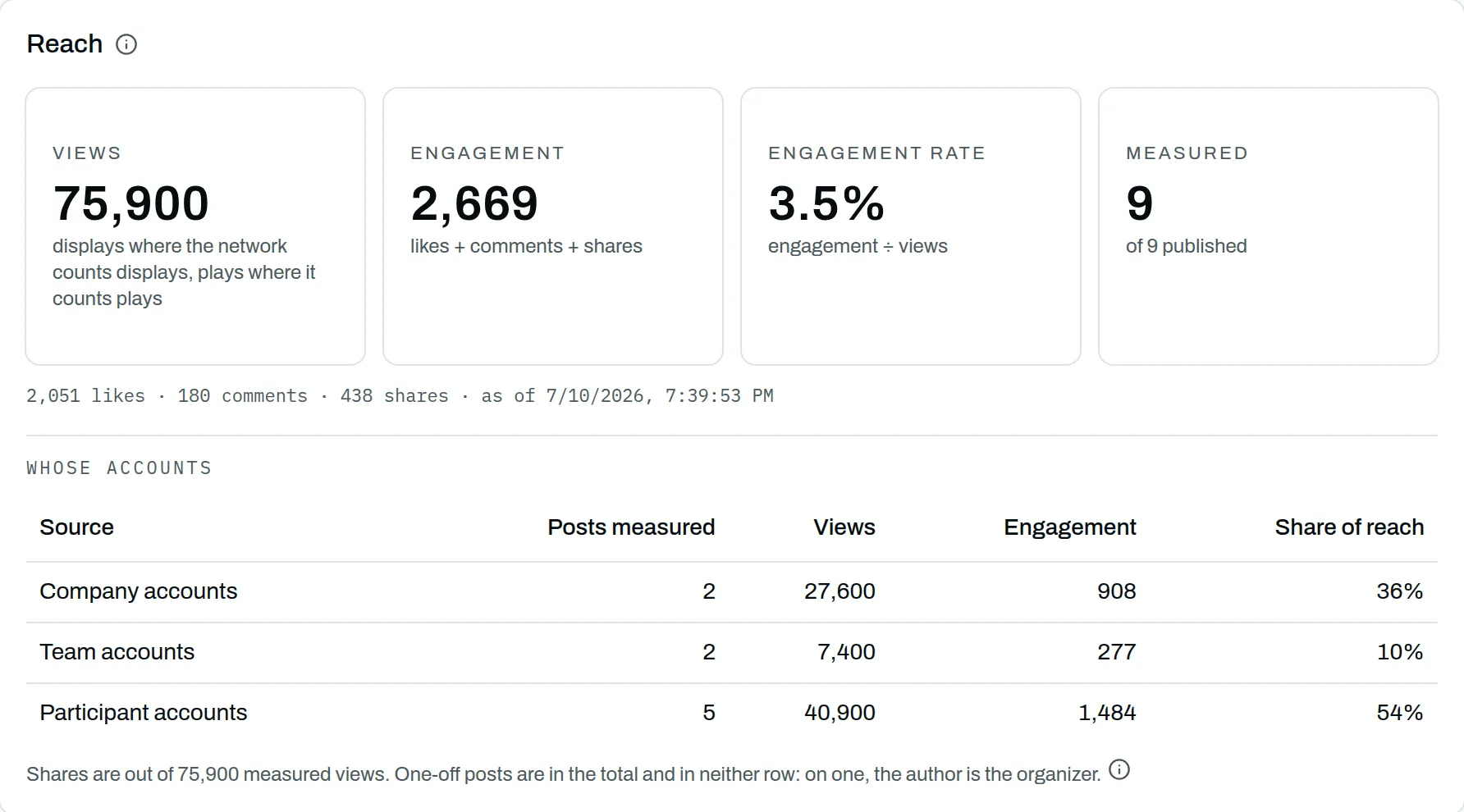
After a launch you want to know two things: did everyone actually post, and did it do anything. The first is answered exactly. The second is answered honestly, which means saying what is not counted.
What gets read, and when
Most posts are read every hour for their first day, then once a day for a week. That is the shape of how a post actually decays: nearly all of it in the first few hours, a long thin tail afterwards. The reading you are looking at always says when it was taken and when the next one lands.
YouTube videos keep being read after that first week, for as long as the channel stays connected: measured 30 times in the first week, then once a month.
X is rationed, and the reason is money: it charges to read a post's numbers as well as to publish one. So an X post is read once, about a day after it publishes, when the number has settled — you will see its figure update far less often than the rest, and that is deliberate rather than broken. Everything the product measures itself, like link opens and who posted on time, covers every post on every network at the same rate.
| Platform | Numbers |
|---|---|
| measured 30 times: about an hour, a day and a week after publishing | |
| measured 30 times: about an hour, a day and a week after publishing | |
| Threads | measured 30 times: about an hour, a day and a week after publishing |
| TikTok | measured 30 times: about an hour, a day and a week after publishing |
| YouTube | measured 30 times in the first week, then once a month |
| X | measured once, about a day after publishing, for the launch post and the 5 posts that drove the most clicks |
| not measured |
X charges for reading a post's numbers as well as writing one, so its reads are rationed rather than blanket.
LinkedIn is the honest gap. It reports nothing readable for posts published from a personal profile, so no number will appear there. The report says that rather than showing a zero, because a zero and "we cannot see this" are different facts and only one of them is about your launch.
Read the totals as a floor
A views count is what the networks reported at the moment we asked. Some report late, some report never, and the ones that do not are simply missing rather than zero. The number is a floor, and every surface that shows it says so.
Views means displays where a network counts displays and plays where it counts plays — TikTok and YouTube report plays, and reading those posts as unmeasured would say nothing happened when thousands of people watched. Where a network reports both, the displays are the figure: a play there had a display before it, so adding the two would count the same person twice. Any total that includes plays says how many.
Two things are counted by LaunchGenius rather than by a platform, so they cover every post: whether it published, and how close to its scheduled time.
Whose accounts carried it
The report splits reach three ways: the company's own accounts, staff accounts, and everyone else.
Whether somebody counted as staff is recorded when they joined the launch, not worked out later. A colleague who leaves next year does not retroactively move out of the team row of a launch they were part of, which would quietly shrink a past report with nothing on the page to explain it.
Link tracking without the surveillance
Each post can carry its own short link to whatever the launch points at. Opens are counted per post, so you can see which post actually sent people anywhere.
What is recorded is the referring site and the country. Not the IP address, not the browser, no cookie. Participants appear in that data as a short code rather than a name or an email address.
A report you can send
Every launch has a report page that works without an account, so it can go to an investor or a CEO as a link. It lists who posted and what their posts did, and the same numbers download as a CSV file for a spreadsheet.
You can replace the link at any time, which stops the old one working.
Failed posts are counted in the totals but never named. A report is not the place to publish that a particular person's post did not go out.
What participants see
Everyone who took part gets their own view of their own posts and what they did. It is private: no leaderboard, no ranking against other participants, no comparison. People helped with a launch; they did not enter a contest.
That privacy is about results. What a campaign's join page shows before the launch, the approved posts participants have planned, is a separate choice with its own switch beside the participation links on the Campaign step.
Last updated 2026-08-31