
Coordinate a social launch
Invite your team, customers, investors and partners to post in their own words, approve them, and publish the whole set on a schedule you control.
Most launch tools schedule your own posts. A coordinated launch schedules everyone else's too.
You pick a moment, called T-0. You write the launch announcement. Then you invite the people who want to help, and each of them writes their own post in their own words. LaunchGenius holds all of it until T-0, then publishes it in the order you planned.
The launch post comes first
Every launch has one announcement per platform. It is the post everything else attaches to: a reply lands underneath it, a repost carries it, a comment answers it.
That ordering is a real constraint rather than a convention. A reply needs the announcement's id on the platform before it can be addressed to anything, so the announcement publishes first and the attached posts resolve against it. A launch cannot be scheduled without one, unless it is a crowd campaign.
A crowd campaign has no launch post
Some launches have no announcement from your own account: the point is the people you invite, each posting in their own words around the launch time. Start one with Start a crowd campaign on the overview, or tick No launch post on a draft campaign's Posts page.
With no launch post there is nothing to quote, reply to or repost, so everyone writes posts of their own. A reply can still go under another post in the launch. You can write posts here too; they go out alongside everyone else's. A crowd campaign schedules itself once a post is approved and the launch time is set.
People join through a link, not an account
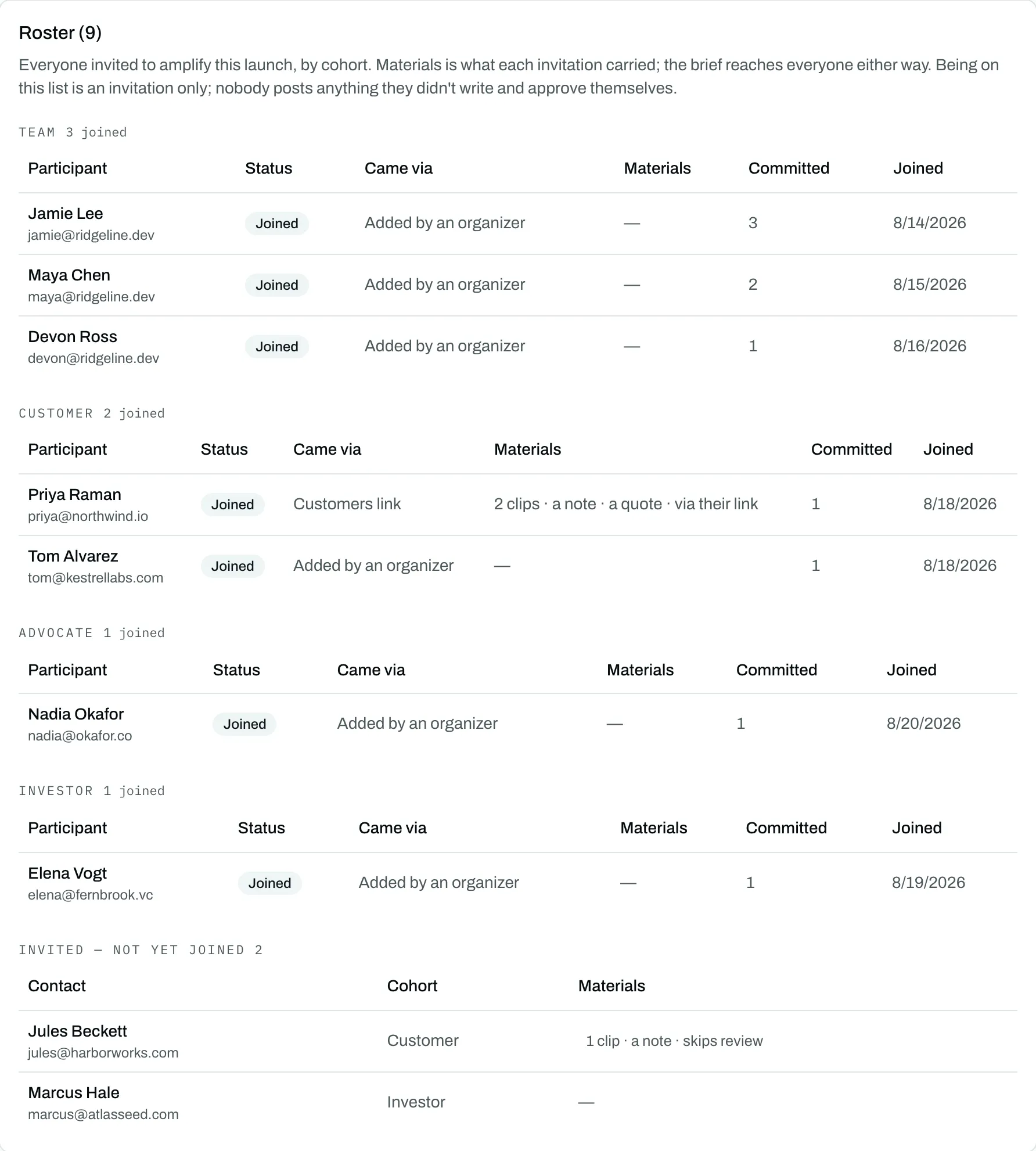
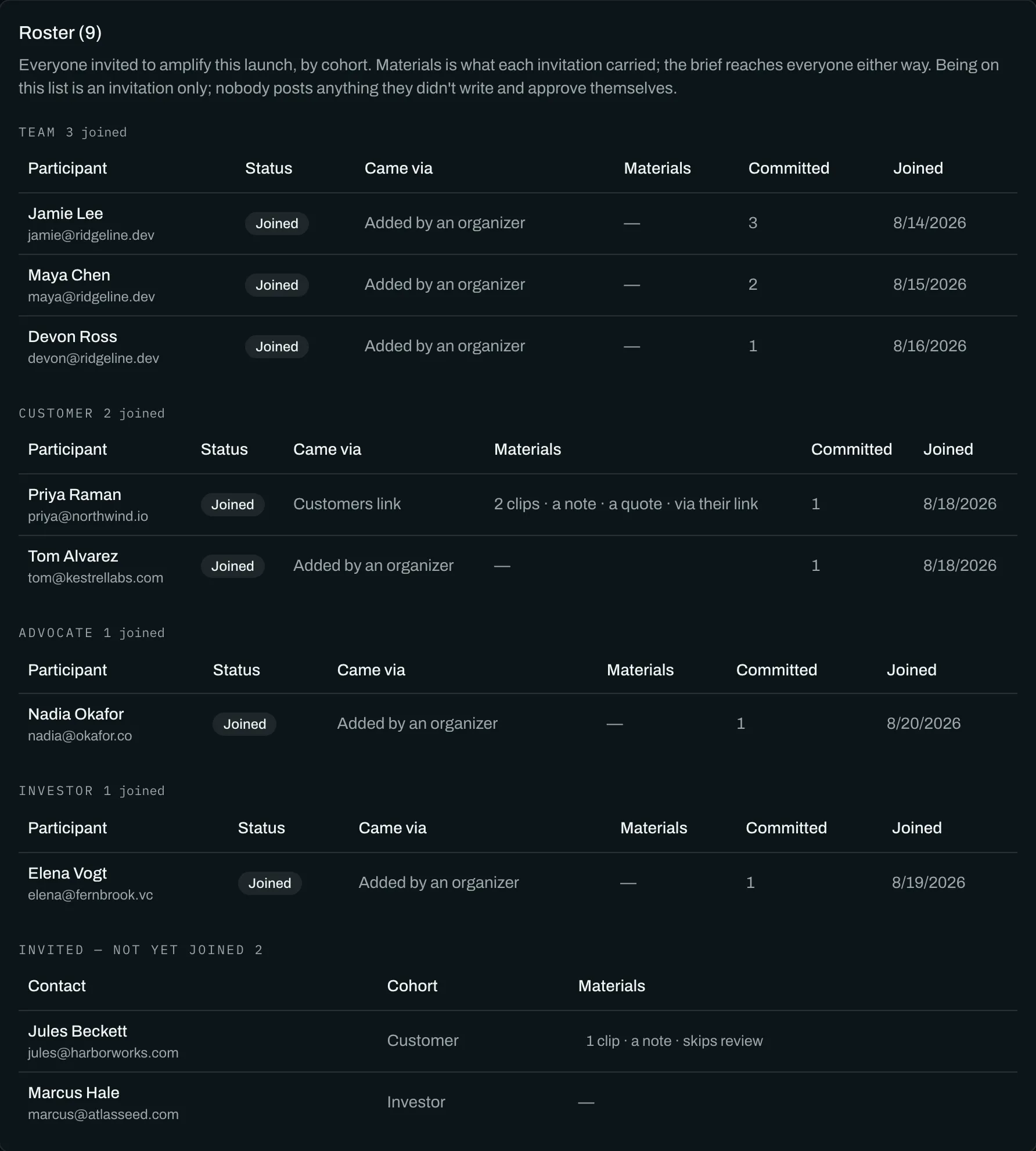
You invite people by sharing a participation link or by pulling a group from your contacts. Joining takes an email address. Nobody needs a password, a paid seat, or an account on LaunchGenius.
A workspace that has never subscribed can build an entire launch and let up to 10 people join and write their posts. Scheduling the launch is the paid step, and the only one.
Cohorts decide when each group posts
Everyone on the roster carries a label. The built-in labels come with a wave, which is the stretch of time that group usually posts in:
| Cohort | Usual wave |
|---|---|
| Team | 2–30 minutes after T-0 |
| Collaborator | 10 minutes to 1 hour after T-0 |
| Guest | 15 minutes to 2 hours after T-0 |
| Guest's comms | 15 minutes to 2 hours after T-0 |
| Customer | 30 minutes to 3 hours after T-0 |
| Advocate | 30 minutes to 3 hours after T-0 |
| Creator | 1–24 hours after T-0 |
| Investor | 2–6 hours after T-0 |
| Partner | 2–6 hours after T-0 |
The wave sets the suggested time when someone writes their post. They can move it. A cohort is a grouping and a default, never a permission, and you can create labels of your own that group the roster without carrying any timing.
Waves matter because twenty posts landing in the same minute reads as a campaign. The same twenty posts spread across an afternoon reads as twenty people who liked something.
You decide which posts wait for your approval
Posts from a person you invited by name arrive for review. You approve them, ask for changes, suggest an edit the author can accept or decline, or reject them.
Posts from people who join through a group link are approved when they submit, so a crowd is not stuck waiting on one organizer. Turn on Review posts from this link on the link's card when you want to read every one first. A personal invite can skip review too, for someone you already trust.
What you cannot do is rewrite somebody's post. Organizers approve words; they do not author them. Nobody publishes a sentence they did not agree to.
Rehearsal is opt-in
A new launch is live: once its launch post is approved, it schedules itself and publishes for real. Turn Rehearsal on under Basics when you want the schedule to run end to end without reaching any platform — statuses move, reports fill in, and the dry-run adapter stands in for every network.
You can flip rehearsal only while the launch is still a draft, before it is scheduled.
Scheduling is reversible
Scheduling a launch is called arming. Before it will arm, LaunchGenius checks that there is an announcement (on a crowd campaign, an approved post), that T-0 is far enough out, and that your plan covers the launch. Anything missing is listed with a link to the place that fixes it.
After that you can still hold the launch, which returns every unpublished item to approved and the launch to draft, with nothing lost. Items that already published stay published.
Last updated 2026-09-30