
Writing posts
A composer that counts characters the way each platform counts them, shows the post as it will appear, and splits threads where you tell it to.
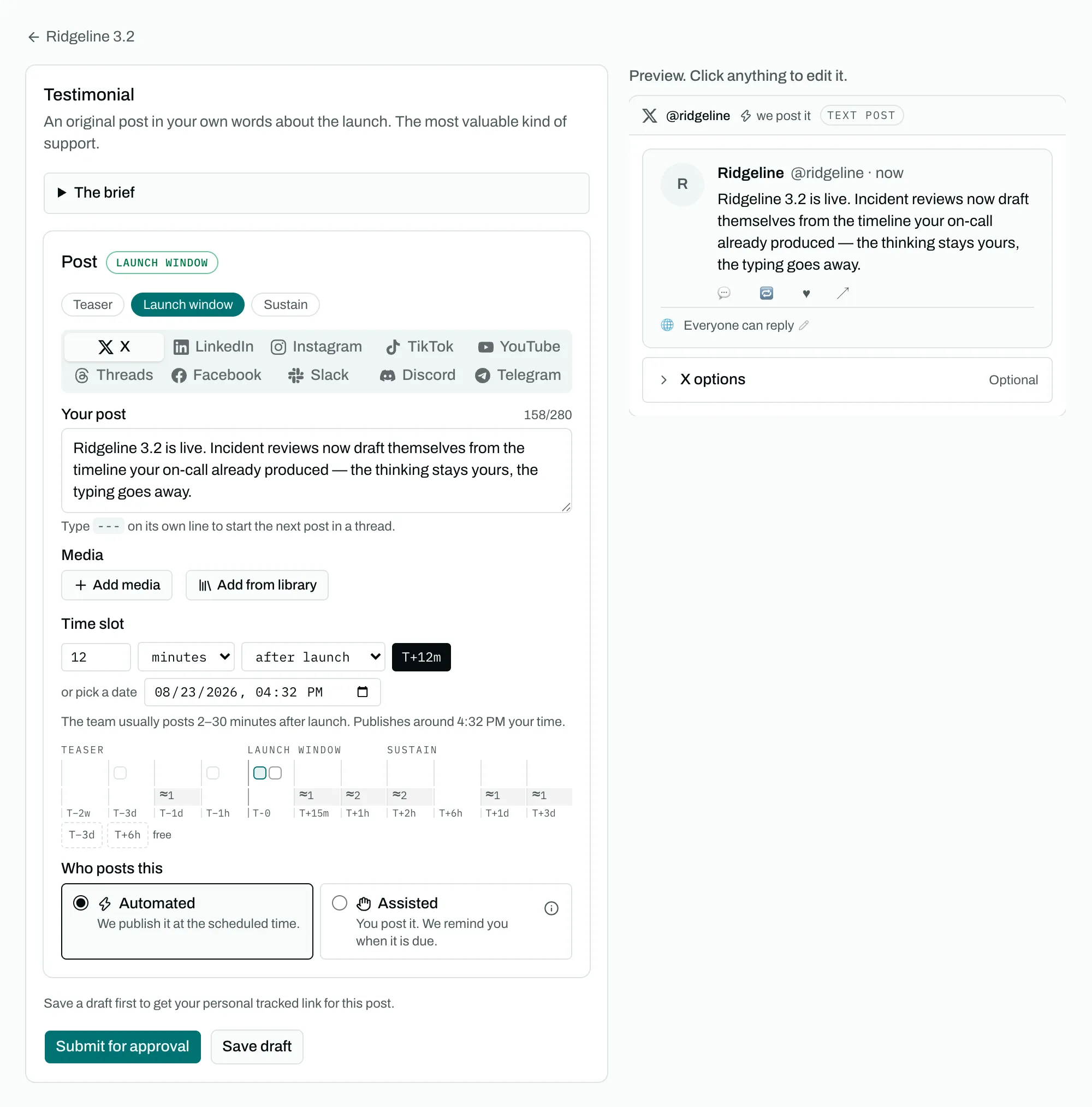
Everyone on a launch writes their own posts. The composer is where they do it, and it is the same tool whether you are the organizer writing the announcement or someone who joined an hour ago.
One timeline, however many posts
A post is a card: write it once, pick the accounts it goes to, and each platform gets its own preview and its own count. Rewrite any one version without touching the others. Queue replies under it to go out after it publishes, attached to it.
A launch that needs more than one post stays on one page. Add the follow-up under the announcement, drop a post between two others and it takes the midpoint of their times, collapse the ones you are not reading. Filing a post under a campaign loads the campaign: every post you have in it, on one timeline, editable in place — and one Schedule sends the lot. One person can carry up to ten posts on one launch.
The four kinds:
| Kind | What it is |
|---|---|
| Testimonial | An original post in your own words about the launch. The most valuable kind of support. |
| Repost | Reposts the launch announcement with your commentary on top (a quote post on X). |
| Reply | A reply under the launch announcement to boost the conversation. |
| Boost | Reposts the launch announcement as-is to your followers. No writing needed. |
Not every kind exists on every platform, and the composer only offers the ones that do. Anything other than an original post has to attach to the launch announcement, so it is offered only where the launch actually has one.
The count matches the platform
Each network counts differently, and the composer counts the way the network does rather than counting characters and hoping.
| Platform | Limit |
|---|---|
| X | 280 |
| 3,000 | |
| 2,200 | |
| Threads | 500 |
| TikTok | 2,000 |
| YouTube | 5,000 |
| 5,000 | |
| Slack | 4,000 |
| Discord | 2,000 |
| Telegram | 4,096 |
Two of those counts are not character counts at all. On X a link counts as 23 regardless of how long it really is, so a post that looks over the limit often is not. On Threads and YouTube the limit is bytes, so an emoji costs more than a letter. The counter knows the difference.
The preview shows the real post
Beside the editor is the post as the platform will render it: the right shape for the images, the right place where the text is cut off with a "more" link, the right handle. Writing a first line that survives the fold is most of the job on a feed, and you can see where the fold lands while you write.
Threads
Split a post with a line of three dashes and each part becomes its own post in a chain, published in order. Nothing else changes about the card, and the preview shows the chain.
Media
Attach images or a video. You can crop, convert a file the platform will not take, and write alt text, and the card stays editable the whole time an upload or an encode is running. Reordering a set of photos while one is still uploading does what you would expect: the new file lands where you put it, not where it would have gone before you moved things.
Files from your workspace's media library can be pulled straight in.
Timing
Every post has a time, written as an offset from the launch moment, T-0. The composer suggests one based on the cohort the author is in, and they can move it anywhere from two weeks before the launch to two weeks after.
Posts scheduled before T-0 have one extra rule: they must be original posts. There is nothing to reply to or repost yet.
No two posts say the same thing
Two people cannot submit the same words on the same platform for the same launch. A wave of identical posts reads as a bot and gets treated like one, so the product refuses it at the point it is written rather than at the moment it would have published.
Last updated 2026-08-21